Contexts · Local-first · Windows

Bring your own integration.

Tical is a local-first time tracker for Windows, built on contexts - each one a plugin that teaches the timer a tool you already work in. Pick a context, hit start, and the hours land where that tool keeps them.

Jira, ClickUp, Trello, Todoist and Pomodoro ship with it. All five are ordinary class libraries on a public SDK - and so is the one your work actually needs, whether you write it or somebody else did.

Launching Q4 2026. Lock in the launch price - $79 instead of $119. It never expires: it waits until you buy.

One email when it ships, no spam. Unsubscribe whenever you like.

One-time purchase · No account · Data stays on your disk · 14-day Pro trial at launch

Tracking00:00:00

The timer takes the shape of the tool

A context is a plugin that teaches Tical one of your tools: where the work lives, what an entry means there, and where the hours go back when you stop. Pick one before you hit start - or run a timer in two at once - and the window rearranges around whichever you are looking at, collapsing the slots it does not use.

TICAL
PRO
Personal
Refactor the sync queue Start
Acme rollout clientmeeting Add tag...
Running (2)
Draft the migration plan Personal 00:41:12
Rewrite the welcome email Trello 00:12:40
TODAY 01:30:17
Write up client meeting notes Acme rollout meeting 00:45:10
Weekly planning No project 00:26:45
Inbox and expenses Admin admin 00:18:22
YESTERDAY 00:55:30
Quarterly invoices Admin 00:34:00
Reading list catch-up No project 00:21:30
Lands in Jira worklog ClickUp time entry Trello card comment Todoist task comment Toggl export Clockify export + whatever you build →

Personal is the one in the box, and the only one the free edition runs. Its hours stay on your disk.

That switcher works - open it and pick one. None of it is a screenshot.

Every integration is a plugin, including ours

The contexts you just switched between aren't special cases baked into the app. Jira, ClickUp, Trello, Todoist and Pomodoro are ordinary class libraries built against Tical.SDK - the same package yours would reference, with no privileged API they get and yours does not. Anything they can do, yours can.

Nothing has to be approved and nothing goes through us. A context is a .dll you drop next to Tical.exe: yours, your team's, or one somebody else published.

Four tools it already speaks

Each one is a Pro context that ships in the box. Pick the thing you are working on, start the timer, and stopping it writes the time where that tool keeps it - the moment you stop, or when you press sync. Each connection is a token you paste into Settings: stored encrypted on this machine, never synced anywhere, and sent only to the service it belongs to.

Jira

Pick a project, then an issue. Stop the timer and the entry is pushed to that issue as a worklog - straight away with auto-sync on, or when you press sync. The issue button opens the issue, comments included, inside Tical, and the picker can be narrowed to the issues assigned to you.

ClickUp

Pick a list, then a task. Stop the timer and the entry lands in ClickUp's time tracking on that task - start, duration and description - with your tags attached if you turn that on. Optionally move the task to another status when the timer stops: Doing to Review, say.

Trello

Pick a board, then a card. Trello has no time field, so stopping the timer posts a comment on the card: duration, description, date and time range, and your tags if you want them there. Optionally keep the card's total hours in a number custom field as well (needs the Custom Fields Power-Up), or move the card from one list to another when the timer stops.

Todoist

Pick a project, then a task. Stop the timer and the entry is a comment on the task: duration, description, date and time range, tags as a plain list. Optionally tick the task off when the timer stops - unless it still has open sub-tasks, in which case Tical leaves it alone and says so. The task's own duration field is never written; that is your schedule, not a log.

Toggl and Clockify are missing on purpose: Tical writes files in their import layout and never connects to either. The exporters sit on the same public SDK as the contexts.

What you get, and what you pay for

The four cards with a Pro badge are the paid half. The seven without are the free edition, and it never expires.

Contexts Pro

Each one brings its own panel, its own entries and its own settings, and the window rearranges around whichever you pick. Jira, ClickUp, Trello, Todoist and Pomodoro ship today, and anything built on the SDK loads the same way. Running a context is what Pro is for.

Export where you bill Pro

CSV or JSON, filtered by date range, workspace and project. Toggl and Clockify import formats ship alongside - files you import there yourself, not a connection to either - and the export API is public, so anything missing is a class library away.

Encrypted sync, your Drive Pro

Your history on your other machine, AES-256-GCM encrypted through your own Google Drive app folder - the passphrase never leaves your machine.

Idle detection Pro

Walk away and Tical notices. When you stop the timer it asks whether the gap counts, and subtracts it from the entry if it doesn't. Off until you switch it on.

Start, stop, done

One keystroke opens an entry, one closes it. Nothing watches your screen and nothing guesses - the log only ever holds what you put there.

Several timers at once

Start a second timer without stopping the first - nothing caps how many. Each run keeps its own row, its own clock and its own stop. Free runs them all in Personal; Pro lets one sit on a Jira issue while another sits on a ClickUp task.

Agents over MCP

Tical speaks MCP, so Claude Code, Cursor or any client that launches a stdio server can start, pause and stop the timer, log and correct entries, and read back what was tracked - under rules you write in plain English and permission switches Tical enforces itself. Off until you switch it on.

Local-first storage

Everything lives in one SQLite file in your own AppData. No account, no upload, and no server that has to be awake for your history to open.

Global shortcuts

Ctrl+Space brings the window up from the tray, Ctrl+K collapses it. Both are rebindable, and both work while Tical is hidden.

Compact mode

Collapse the whole app to one strip - context, label, project, the newest timer and a +N pill that opens the rest - and park it above whatever you're actually working in.

Offline licensing

Your key is signed and checked on your own machine. Nothing phones home, and nothing stops working because a server had a bad day.

What it looks like on your machine

No dashboard, no browser tab. One small window that stays out of the way until you need it.

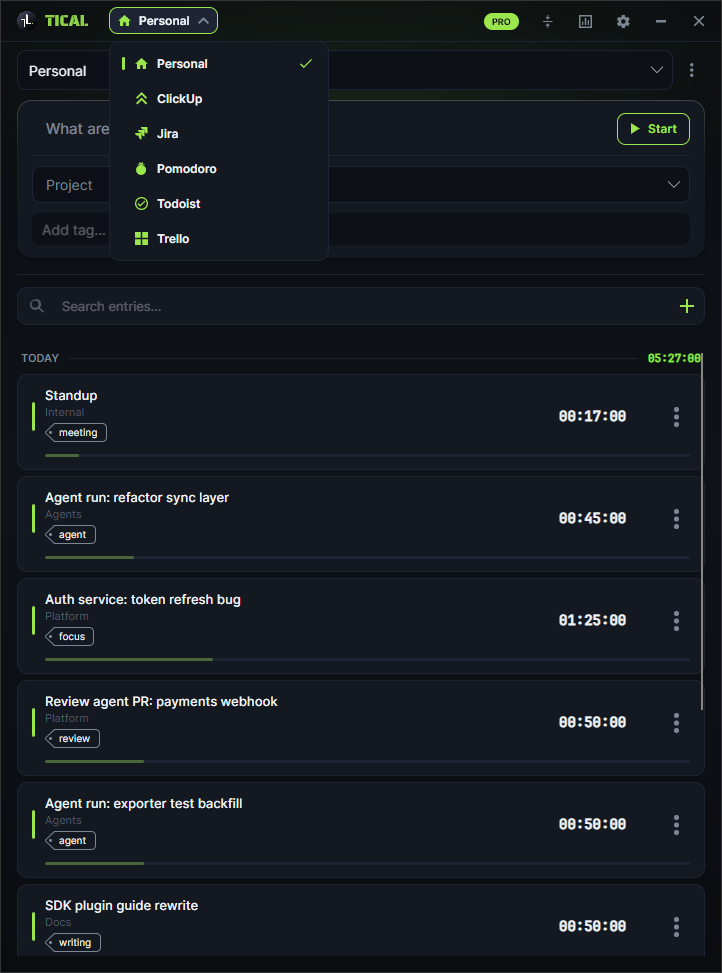
The Tical context switcher open from the title bar, listing Personal, ClickUp, Jira, Pomodoro, Todoist and Trello contexts with Personal ticked as active, above the composer and the day's entries totalling 5 hours 27 minutes.
Switch context and the window rearranges around it. Stop the timer and the worklog is already in Jira. Jira, ClickUp, Trello, Todoist and Pomodoro are ordinary plugins built on the same SDK as yours.
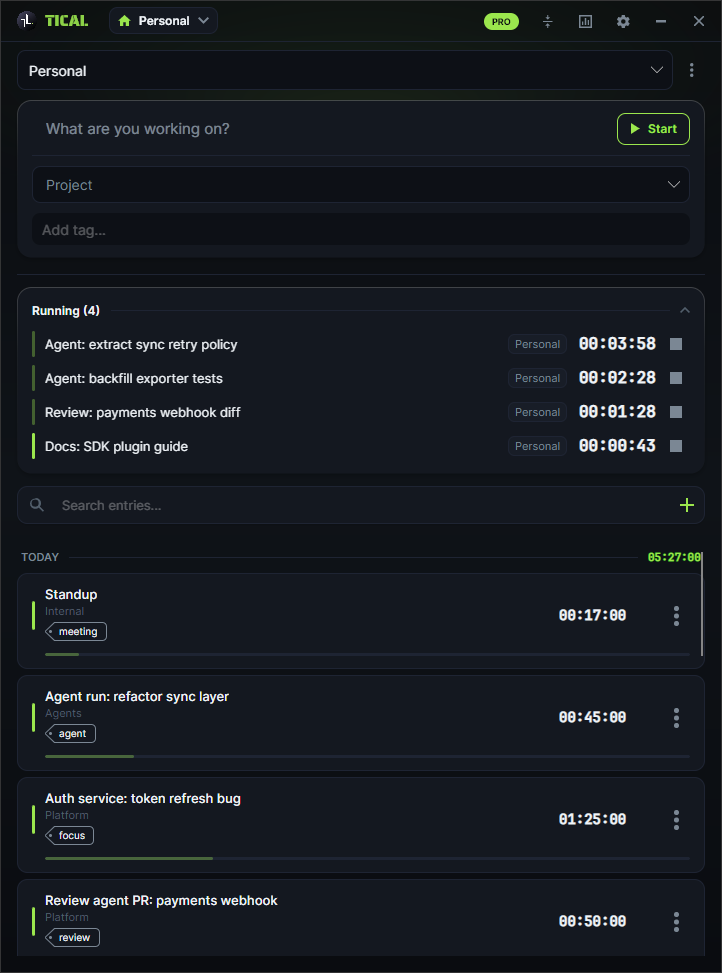
The Tical window with a Running (4) panel listing four timers going at the same time - an agent extracting a sync retry policy at three minutes 58, another backfilling exporter tests at two minutes 28, a payments webhook review at one minute 28 and an SDK plugin guide at 43 seconds - each with its own context chip, clock and stop button, above the day's finished entries totalling 5 hours 27 minutes.
Four timers running at once, each with its own row, clock and stop. Starting one never stops another, and nothing caps how many.
Tical in compact mode: the title bar with the Personal context pill and a PRO badge, a strip holding an empty description box, a running timer at 52 seconds, a round start button and a stop button, and a second row with a tags dropdown and a project picker.
Compact mode collapses the whole app to one strip you can park above everything else.

Buy it once

The free edition is the timer, and it never expires. Pro is the contexts - one payment for all of them, with no tier above it and no renewal email waiting for you in eleven months.

Free

For tracking your own hours, on your own machine.

$0 forever

The timer, with no account, no card and no expiry date. Your history is one file in your AppData and it stays there.

  • 14 days of Pro to start - no card
  • Several timers at once
  • Projects, as many as you need
  • Tagging on every entry
  • One workspace
  • Global shortcuts
  • Compact mode
  • Agent access over MCP - off until you switch it on
Notify me when it ships

Windows · free forever

There are four ways to pay less than this.

Already own Tical?

A license covers one machine. A second computer is $39 rather than a full second license - as long as both machines sync to the same Google Drive account.

Add a second machine

The things people ask first

When does it launch?

Q4 2026. The build ships to the waitlist first, so joining the list is how you get it before this page changes - and it locks in the $79 launch price.

What's the launch price?

$79 at launch, $119 after. Everyone on the waitlist gets the launch price whenever they buy, so there is nothing to watch for and no window to miss. The lock has no expiry date: it holds until you buy, whether that is next month or next year. We honour it with a discount code sent to the address you signed up with, so it survives a price rise rather than expiring with one.

What is a context?

A plugin that teaches Tical one of your tools. It brings its own panel into the window, its own list of things you can track against - Jira issues, ClickUp tasks, Trello cards, Todoist tasks - and its own idea of where the hours go when you stop. Jira, ClickUp, Trello, Todoist and Pomodoro ship with Tical; the SDK behind them is on nuget.org, so a context for the tool you actually use is a class library rather than a feature request.

Can I use a context somebody else wrote?

Yes. A context is a .dll you drop next to Tical.exe, and Tical loads it exactly as it loads ours - there is no store, no review and no key to get. That also means you are trusting whoever wrote it with whatever it can reach, the same as any other program you run, so take them from somewhere you would take a program from.

Does Tical work offline?

Yes, all of it. Your license key is signed once and then checked on your own machine, so the app never needs a connection to keep running - not at startup, not after a week on a plane, and not on the day our server has an outage.

Is Tical a subscription?

No. Tical Pro is a single payment for a perpetual license, and updates within your major version are included. There is no renewal, no seat count and no tier above Pro.

Where is my time tracking data stored?

In one SQLite file on your own disk. Nothing is uploaded to us. If you want your history on a second machine, Pro syncs it encrypted through your own Google Drive - still never through our servers.

Does Tical run on macOS or Linux?

Not today. Tical is a Windows desktop app: the tray timer and the global shortcuts both sit on Windows APIs. Tell us on the feedback page if another platform is what is stopping you.

Does Tical watch my screen or take screenshots?

No. Tical records only the entries you start and stop yourself, or that an agent you have connected starts and stops for you - and that connection is off by default. It does not read window titles, log which applications you use, or capture your screen. While a timer is running it notices that the machine has gone idle, and only so it can ask what to do with the gap when you stop.

Can Tical log time to Jira, ClickUp, Trello or Todoist?

Yes, with Pro. Pick the issue, task or card in that context, track against it, and stopping the timer writes the time where the tool keeps it: a worklog on the Jira issue, a time entry on the ClickUp task, and a comment on the Trello card or Todoist task, because neither of those has a time field. Pushed the moment you stop or when you press sync, whichever you set. All four are ordinary plugins built on the public Tical SDK.

Can I run several timers at once?

Yes, as many as you like, on Free as well - starting one never stops another. Each run gets its own row with its own clock and its own stop, and the tray tooltip counts what is running. Free runs them all in Personal, since every other context needs Pro; with Pro one timer can sit on a Jira issue while another sits on a ClickUp task. Pomodoro is the exception: its engine is one work-and-break cycle, so it runs a single timer of its own while everything else carries on beside it.

Can I move my license to a new computer?

Yes - up to two free transfers in any rolling 12-month period. A license is active on one machine at a time: email us from the address you bought with, we retire the old key and issue a new one signed for the new machine. The old key stops working; your entries don't, because they are a file on your own disk. Hardware died and you are out of transfers? Write to us - genuine failures are handled case by case. The details are in the terms.

What do I get in the free version?

The timer, with no time limit, no card and no account - one workspace, as many projects, tags and simultaneous timers as you want, the global shortcuts, compact mode and the agent connection over MCP. What it does not do is load a context. Jira, ClickUp, Trello, Todoist, Pomodoro and anything built on the SDK need Pro, and so do export, idle detection and encrypted Drive sync.

Does Tical sync with Toggl or Clockify?

No, and the difference matters. Tical writes CSV files in the column layout Toggl and Clockify expect for a bulk import, and you upload those there yourself. It never contacts either service, holds no token for them, and nothing comes back the other way. Jira, ClickUp, Trello and Todoist are the ones that genuinely connect.

Is there a free trial?

Yes - 14 days of the whole of Pro, and every copy of Tical starts with it. No card, no account, nothing to cancel. When the 14 days are up Tical settles into the free edition, which never expires, and everything you tracked stays exactly where it is. One trial per computer. Until the build ships, the waitlist is how you get both.

Is there a refund policy?

Yes. You have 14 days from purchase for a full refund, as long as your license key has not been redeemed - redeeming it is what starts delivery. Once a key is signed for your machine the statutory right is gone, but if it genuinely does not work for you, write to us within those 14 days and we will normally refund you anyway. That is also what the free edition is for: it never expires, so nobody has to buy blind.

What happens to my entries if my license lapses?

Nothing happens to them. Your entries are a file on your own disk and Tical never deletes them. A perpetual license does not lapse in the first place, but if you run a copy no key covers, the free caps apply to what you make from then on and everything already tracked stays exactly where it is.

Can I use Tical on two computers?

Yes, for $39 rather than a second full license. Add one at tical.io/second-machine using a code copied from the computer you already licensed. A second machine is tied to the same Google Drive account as the first, and Tical re-checks that every time it starts - so both machines have to be signed in to that one account, and the first has to still be syncing. A third at once is a full license. Replacing one computer with another is a different thing again and costs nothing - that is the free transfer above. What travels either way is your history: Pro syncs it encrypted through your own Google Drive. It copies the database whole and the newest copy wins, so sync before you switch machines rather than after. That Google review is still in progress, so you get an unverified-app screen once when you connect - and Drive sync is off until you switch it on, because nothing else in Tical needs it.

Does Tical need an installer or admin rights?

Neither. The download is a zip holding one self-contained executable. Unzip it anywhere you can write, including a folder inside your own profile, and run it. Nothing is registered and no service is installed - deleting the folder takes the app with it, and your entries sit in your AppData folder until you delete those too.

Can I write my own integration?

Yes, and it is the point of the app. Tical.SDK and Tical.SDK.Core are published on nuget.org, and the Jira, ClickUp, Trello, Todoist and Pomodoro contexts are built on exactly those two packages - no privileged internal API they get and yours does not. Point one at whatever your work runs on, drop the .dll next to Tical.exe, and it appears in the switcher. The full reference is on the SDK page.

Can an AI agent use Tical?

Yes. Tical has an MCP server built in, off until you switch it on in Settings under Agents. Claude Code, Claude Desktop, Cursor, Codex CLI or any client that can launch a stdio server connects by running Tical.exe with --mcp, over a local pipe only your Windows account can open. The agent can start, pause, resume and stop the timer, log and correct entries and read reports. It follows rules you write in plain English, and Tical itself enforces the permission switches beside them, so anything you turn off is refused however the agent asks. Agent access is free; whatever needed Pro before - contexts, reports past seven days, a second workspace - still does when an agent asks for it.

Get Tical for Windows

The app is the same download whether you stay on Free or buy a license - a key unlocks what is already installed, rather than swapping it for a different build.

Not out yet. Q4 2026, and the build goes to the waitlist before this page changes. Joining also holds the $79 launch price for whenever you buy.

One email when it ships. The launch price comes with it.

Windows · available soon

The plugins and exporters we ship are packaged separately from the app, so they can be updated without a new build. Unzip either one next to Tical.exe. Loading them needs a Pro license.

Tell us what Tical should do next

Missing something, or found something broken? It goes straight to the person building it - no account, no sign-in, and an email address only if you want a reply.

Activate your license

Your receipt has a redemption link. Open it, paste the hardware code from Tical → Settings → Licensing, and your signed key comes back straight away.